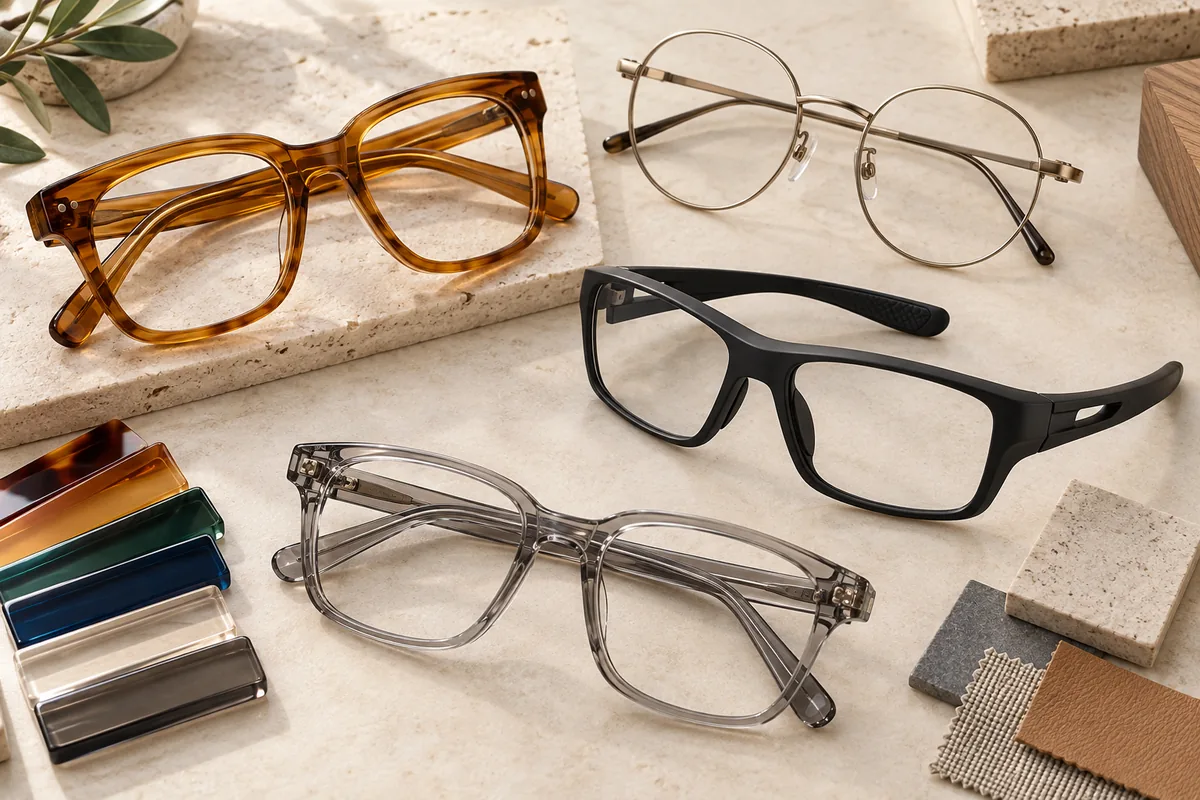
Choosing eyeglass frame materials is a commercial decision as well as a design choice. Material affects how a frame feels, which shapes and finishes are practical, how an optician can adjust it, and what needs checking before a wholesale order.
For eyewear brands, distributors and optical retailers, acetate, TR90, stainless steel and titanium offer different starting points. None is the best choice for every collection. Use this guide to match the material to your customers, compare supplier specifications and approve samples with greater confidence.
Acetate vs TR90 vs metal: a quick answer for buyers
Choose acetate when color depth and sculpted shapes are priorities. Consider TR90 when your brief emphasizes low weight and flexibility. Compare stainless steel for slim metal designs and titanium for a premium lightweight range. The right choice still depends on fit, construction, lens requirements and the approved sample.
Start with the wearer and the product brief
Before comparing materials, define the intended wearer, sales channel, target retail price and prescription-lens requirements. A bold fashion collection has different priorities from a thin everyday frame or a lightweight range for active use.
Write down the required eye size, bridge design, temple length, overall width and preferred wearing weight. Include the lens types your dispensing partner expects to fit. Strong prescriptions, deep lens shapes and larger eye sizes can affect finished spectacle weight, so evaluate the complete frame-and-lens combination where possible.
Then decide which requirements are essential: rich color patterns, a slim profile, easy adjustment, corrosion resistance or a particular price position. This makes material selection more useful than choosing from a label alone.
Optical frame materials at a glance
| Material | Typical strengths | Points to check | Possible collection role |
|---|---|---|---|
| Cellulose acetate | Rich colors, layered patterns and sculpted shapes | Finished weight, bridge fit, polishing and adjustment guidance | Fashion-led optical ranges and expressive designs |
| TR90 | Low weight and flexibility, depending on resin and construction | Exact resin, hinge design, finish adhesion and lens-fitting instructions | Lightweight everyday collections |
| Stainless steel | Thin profiles and a broad range of metal finishes | Alloy, coating quality, joints, nose pads and nickel-release requirements | Minimalist and versatile metal-frame ranges |
| Titanium | Low density and good corrosion resistance | Pure titanium versus alloy, component coverage, joints and cost | Premium collections with lightweight positioning |
These are general material characteristics. Frame geometry, component selection, surface treatment and workmanship can change the result substantially. Compare finished samples of similar size rather than assuming a material name guarantees comfort or durability.
Acetate frames: color, depth and shape
Cellulose acetate is widely used for optical frames with translucent colors, tortoiseshell effects and layered patterns. Sheet-based construction allows designers to work with thickness, bevels and polished edges, making it a useful option when the frame itself is a central part of the look.
A thicker acetate frame can feel substantial, while a carefully designed thinner model may feel quite different. Ask for the weight of the actual model and compare bridge contact, temple pressure and balance during a fitting trial. A visually appealing bridge is not automatically a comfortable bridge for your target customers.
On samples, inspect the polish around the lens rims, bridge and temple ends. Look for rough edges, uneven surfaces, exposed reinforcement and poorly finished hinge areas. Agree an acceptable range for patterned colors: individual pieces can differ, so a single photograph may not define the whole production batch.
Ask the supplier for adjustment and lens-fitting instructions. Acetate can often be adjusted by a trained optical professional using appropriate heat, but excessive heat can distort the frame. Do not assume the same process works for every construction.
TR90 frames: verify the resin and the finished construction
Grilamid TR 90 is part of EMS-GRIVORY’s transparent polyamide range, described in its optics materials information. In eyewear quotations, the label TR90 alone does not establish the exact resin, its origin or its performance. Request a written material specification, particularly if a specific branded resin is part of your purchase requirement.
Flexibility can be useful for everyday wear, but it should be assessed alongside dimensional stability and hinge design. A frame that bends easily is not necessarily resistant to every kind of damage. Compare how the temples open and close, whether the frame returns to its intended shape, and how the bridge sits during wear.
Check the finish at hinge connections and any contact points between different materials. If the frame is painted or coated, discuss how finish adhesion is evaluated. Also confirm the recommended lens insertion method and adjustment limits; polymer frames should not automatically receive the heating or bending procedures used for acetate or metal frames.
Stainless steel frames: thin profiles with component checks
Stainless steel supports slim rims and temples, which can suit restrained shapes and everyday optical collections. A thin frame may look light, but comfort still depends on its dimensions, nose-pad contact and the weight distribution of the finished spectacles.
Inspect joints, rim closures, screws, pad arms and temple alignment. Open and close the temples on each sample and look for inconsistent movement or excessive play. Check coating consistency at edges and joints, where finish defects may be easier to see.
Do not describe every stainless steel frame as nickel-free or allergy-safe. Alloy composition, coatings and the components touching skin all matter. Ask for relevant material and nickel-release documentation when required for your destination market, and make sure it covers the supplied model or applicable components.
Titanium frames: clarify what the description includes
Titanium is valued for low density and corrosion resistance, making it a useful starting point for premium lightweight eyewear. However, total frame weight also depends on design, dimensions and the other components used.
Clarify whether the quotation refers to commercially pure titanium, a titanium alloy or a mixed-material construction. Beta-titanium is an alloy designation often associated with flexible components; it is not interchangeable with every titanium specification.
Ask which parts are titanium: the front, temples, bridge, pad arms and hinges may use different materials. Evaluate joint quality, alignment, surface finish and the supplier’s guidance for adjustment or repair. A “titanium” label should match the written specification and your product description.
Use a consistent sample approval checklist
Compare candidates against the same criteria and retain an approved reference sample. Your eyewear quality-control process should connect the buying brief to measurable inspection requirements.
- Material and components: Record the specified material for the front, temples, hinges, screws and nose pads, including any substitutions that require approval.
- Dimensions and fit: Check eye size, bridge, temple length, overall width, alignment and comfort on representative wearers.
- Lens compatibility: Confirm the intended lens types and fitting method with the supplier and your dispensing partner. Demo lenses do not prove compatibility with every prescription.
- Assembly and finish: Examine edges, joints, hinge movement, screws, plating or paint, logo placement and cleanliness.
- Documentation: Agree the standards, reports and labeling needed for the exact product and destination. A generic certificate is not a substitute for checking its scope.
- Repeatability: Record the model, color references, approved artwork, packaging and inspection criteria in a dated specification.
Where laboratory testing is required, agree the method and acceptance criteria before bulk production. Handling a sample can reveal obvious issues, but it does not replace mechanical, chemical or other applicable testing.
Compare the full quotation, not only the material name
Send each supplier the same brief and request a breakdown by model and color. Confirm whether minimum order quantities apply to the frame, each color, a custom component or branded packaging. Separate sample charges, tooling, logo setup, packaging and delivery terms from the unit price.
For a private-label eyewear project, decide whether you need an existing model with branding or a new design. New shapes, proprietary components and special colors can change development steps, minimums and timelines. Request a project-specific schedule rather than relying on a general lead-time statement.
Frequently asked questions
Which optical frame material is the lightest?
There is no reliable answer from the material name alone. TR90 and titanium can support lightweight designs, but frame size, section thickness, hinges and lenses affect the finished result. Compare measured samples with similar dimensions.
Are acetate frames better than TR90 frames?
They serve different design needs. Acetate offers broad color and pattern possibilities, while TR90 is often selected for low weight and flexibility. Fit, finish, lens compatibility and your collection’s price position should guide the decision.
Does a titanium frame guarantee suitability for sensitive skin?
No single material label establishes the suitability of every component. Confirm the composition and finish of all skin-contact parts and request applicable documentation before making a specific skin-sensitivity claim.
What should a wholesale optical frame inquiry include?
Include your target market, material preference, frame dimensions, quantities by model and color, lens requirements, branding, packaging and required delivery window. State any mandatory tests or documents at the inquiry stage.
Plan your next optical frame range with OUSIKI OPTICS
Use the material comparison to prepare a shortlist, then compare physical samples against a clear specification. Explore OUSIKI OPTICS’ optical frame range and request a catalog, samples or a quotation. Share your preferred materials, target market, model references and order quantities so availability, customization and timing can be confirmed for your project.
From insight to product
Explore Core Eyewear Categories
Compare product categories, OEM/ODM capability and supply options related to this article.
Sunglasses Manufacturer
Sunglasses for wholesale, OEM/ODM and private label programs.
Explore →Optical Frame Supplier
Optical frames in TR90, metal, acetate and mixed constructions.
Explore →Sports Eyewear Manufacturer
Sports eyewear for cycling, running, outdoor and active markets.
Explore →Custom Eyewear Packaging
Cases, cloths, labels, boxes and branded presentation.
Explore →